
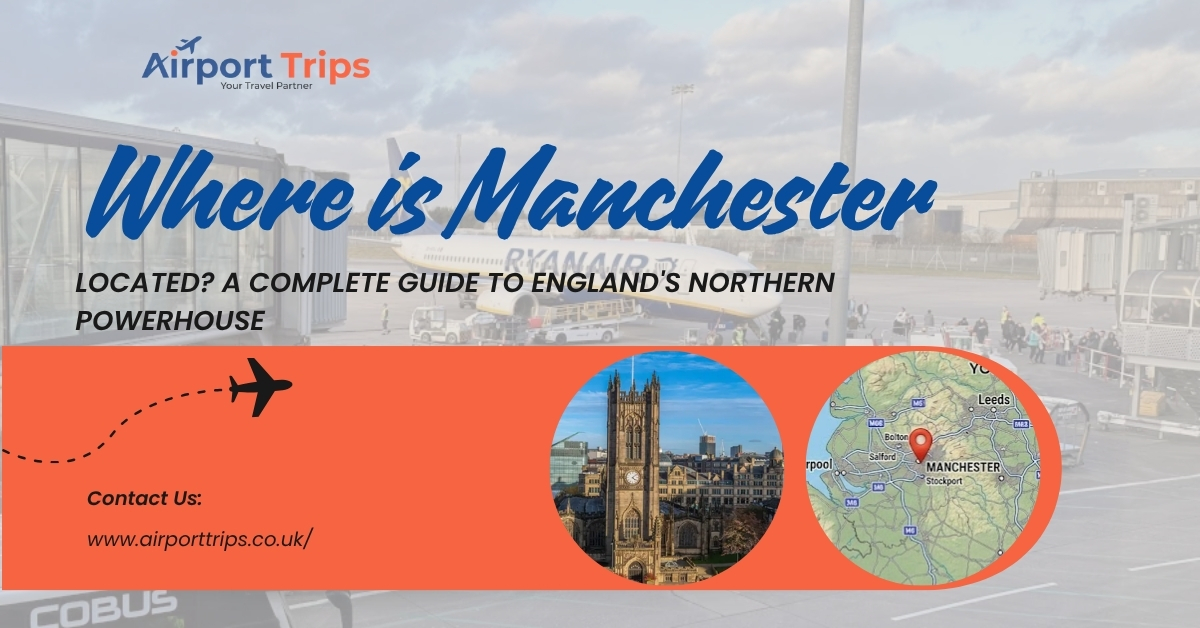
Manchester is located in North West England, in the United Kingdom, roughly 200 miles (320 km) north-west of London and 35 miles (56 km) east of Liverpool. It sits within the metropolitan county of Greater Manchester, on the eastern edge of the Cheshire Plain, with the Pennine hills rising just beyond its suburbs. If you’re planning a visit, you’ll find it one of the best-connected cities in Britain — by air, rail, and road.
That’s the short answer. But if you’re weighing up a trip, there’s plenty more worth knowing about where Manchester sits on the map, what makes it tick, and how to plan your journey. This guide covers it all.
Where Is Manchester in the UK?
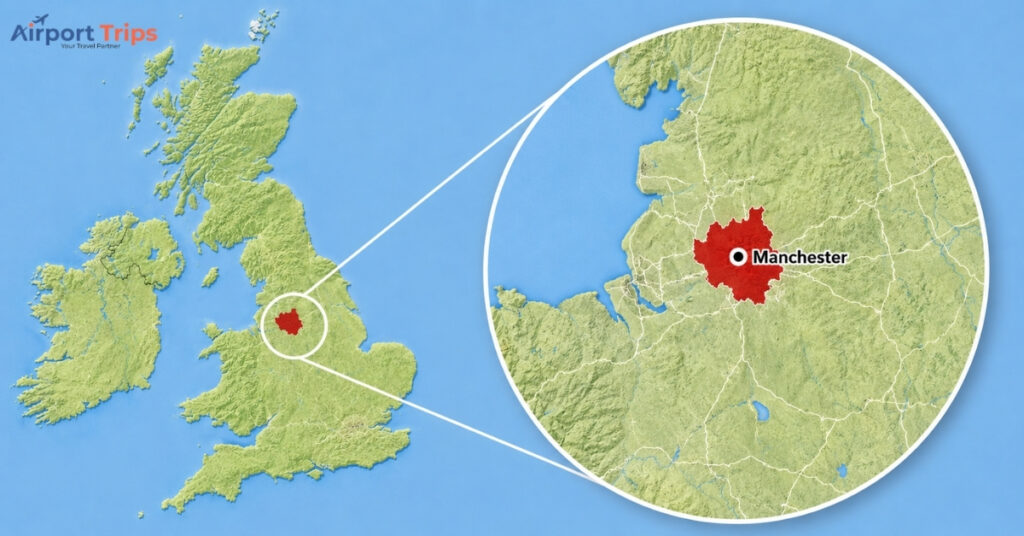
Ask anyone in Britain where in the UK is Manchester, and they’ll point to the top-left of England. The city anchors North West England, one of the country’s nine official regions, alongside Liverpool, Preston, and the Lake District.
To place it precisely on a UK map:
- Coordinates: 53.48° N, 2.24° W
- Region: North West England
- County: Greater Manchester (metropolitan county)
- Distance from London: approx. 200 miles / 320 km (2 hrs 10 mins by train)
- Distance from Liverpool: approx. 35 miles / 56 km
- Distance from Leeds: approx. 40 miles / 64 km
- Distance from Edinburgh: approx. 215 miles / 345 km
The city lies in a natural bowl. The Pennines — often called the “backbone of England” — curve around it to the north and east, while flat plains stretch west towards the Irish Sea. The River Irwell runs through the city centre, separating Manchester from its twin city, Salford.
Where Is Manchester in Europe?
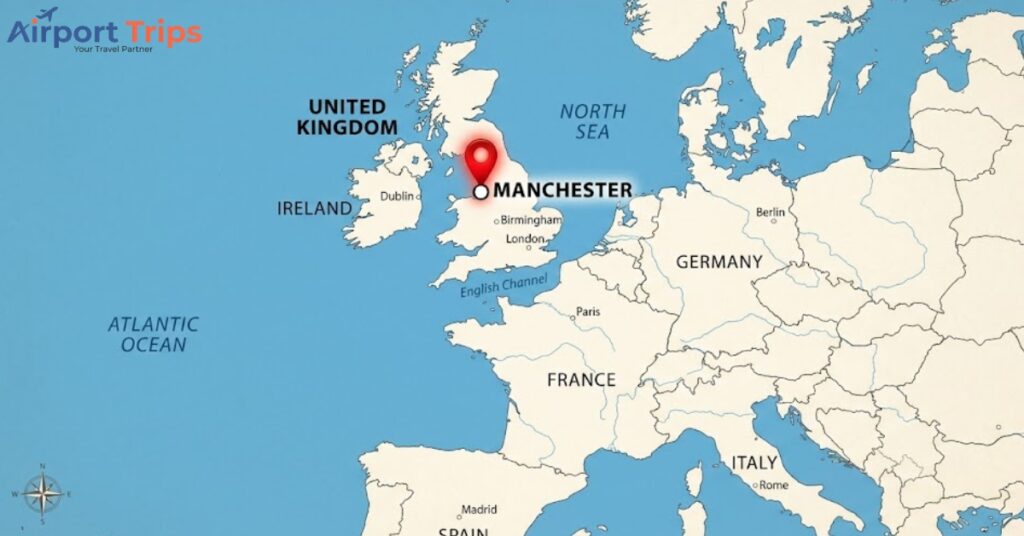
Zooming out, Manchester sits in north-west Europe, on the island of Great Britain. It’s one of the UK’s principal gateway cities for international travellers, and its position makes it remarkably accessible:
- 2–3 hours’ flying time from most major European capitals, including Paris, Amsterdam, Madrid, and Berlin
- Direct long-haul routes to the USA, the Middle East, and Asia via Manchester Airport
- Served by the M6, M62, and M56 motorways, linking it to Scotland, Yorkshire, the Midlands, and North Wales
Manchester Airport, around 9 miles south of the city centre, is the busiest UK airport outside London, handling close to 30 million passengers a year across three terminals. For most international visitors, it’s the front door to Northern England — and a pre-booked airport transfer is the smoothest way to cover those final nine miles into the city.
Is Manchester a City or a County?
This trips up plenty of first-time visitors, so let’s settle it.
Manchester is a city. It received its city charter in 1853 and is governed by the Manchester City Council. Greater Manchester is a metropolitan county—created in 1974 — that encompasses the city and nine neighbouring boroughs, including Salford, Stockport, Bolton, Bury, and Trafford.
So when someone says “Manchester”, they might mean either:
- The City of Manchester — population around 570,000, home to the city centre, both universities, and most major attractions
- Greater Manchester — population around 2.9 million, the wider urban area that includes Old Trafford (technically in Trafford) and Manchester Airport (largely in the borough of Manchester, on the Cheshire border)
For travel purposes, the distinction rarely matters. The whole conurbation functions as a single destination, linked by the Metrolink tram network — the largest light rail system in the UK.
What Is Manchester Famous For?
Few cities punch above their weight quite like Manchester. Here’s what put it on the world map:
- Football. Home to two giants — Manchester United at Old Trafford and Manchester City at the Etihad Stadium. Match days bring tens of thousands of visitors, and stadium tours run year-round.
- Music. The birthplace of Oasis, The Smiths, Joy Division, New Order, and The Stone Roses. The legendary Haçienda nightclub shaped British music culture, and the city’s live scene is still thriving.
- The Industrial Revolution. Manchester was the world’s first industrial city — nicknamed “Cottonopolis” in the 19th century when it dominated the global textile trade. The Science and Industry Museum tells that story brilliantly.
- Science and innovation. The atom was first split here by Ernest Rutherford, the world’s first stored-program computer ran here in 1948, and graphene was isolated at the University of Manchester in 2004, earning a Nobel Prize.
- Media. MediaCityUK in Salford Quays hosts the BBC and ITV, making Greater Manchester the UK’s second media hub after London.
Top Manchester Landmarks and Attractions
Planning your itinerary? These are the Manchester attractions visitors consistently rate highest:
| Attraction | What It Is | Best For |
| Old Trafford | Manchester United’s stadium & museum | Football fans |
| Etihad Stadium | Manchester City’s home ground | Football fans |
| Science and Industry Museum | Industrial heritage at the world’s oldest railway station site | Families, history lovers |
| Manchester Cathedral | Medieval cathedral, 600+ years old | Architecture, history |
| John Rylands Library | Stunning neo-Gothic library on Deansgate | Culture, photography |
| Northern Quarter | Independent shops, street art, bars, and cafés | Food, nightlife, and vintage shopping |
| Salford Quays & MediaCityUK | Waterfront with The Lowry and IWM North | Art, museums, dining |
| Manchester Art Gallery | Pre-Raphaelite masterpieces, free entry | Art lovers |
| Castlefield | Roman fort remains and canal-side bars | Relaxed afternoons |
| Chinatown | One of the UK’s largest, behind a grand paifang arch | Authentic East Asian food |
Most city-centre sights sit within a walkable square mile, with the free city-centre bus and Metrolink trams covering everything else.
Is Manchester a Good Place to Visit?
In a word: yes. Manchester regularly features in “best places to visit” lists from major travel publishers, and it earns the praise for a few simple reasons:
- It’s compact and easy. You can land at Manchester Airport and be in the city centre within 20–25 minutes by car.
- It’s a good value. Hotels, restaurants, and attractions typically cost noticeably less than in London.
- There’s genuine depth. World-class sport, free museums and galleries, a celebrated food scene from Michelin-starred Mana to the Curry Mile, and nightlife that needs no introduction.
- It’s a brilliant base. The Peak District, Liverpool, Chester, and the Lake District are all easy day trips.
The weather has a soggy reputation — pack a light waterproof — but the city more than compensates indoors.
Which Cities Are Close to Manchester?
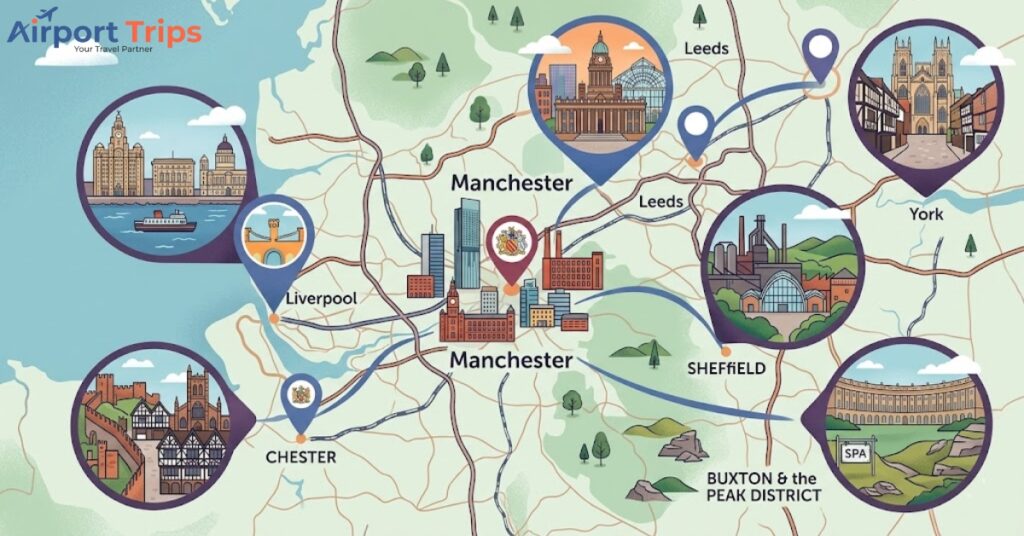
Manchester’s central position in Northern England makes it an ideal hub for exploring further:
- Liverpool — 35 miles west (under an hour by train): The Beatles, two cathedrals, a UNESCO-listed waterfront heritage
- Leeds — 40 miles east (50 minutes by train): shopping, Victorian arcades, Royal Armouries
- Chester — 40 miles south-west: Roman walls and Tudor streets
- Sheffield — 38 miles south-east: gateway to the Peak District
- York — 70 miles north-east: medieval walls, the Shambles, York Minster
- Buxton & the Peak District — 25 miles south-east: Britain’s first national park
A private transfer or hire car opens all of these up comfortably in a day, and many visitors combine Manchester with Liverpool or the Peaks in a single trip.
Getting to Manchester: Practical Travel Tips
- By air: Manchester Airport (MAN) serves 200+ destinations. From the airport, you can reach the city centre by train (about 20 minutes to Piccadilly), Metrolink tram, or — the most comfortable option after a long flight — a pre-booked door-to-door airport transfer that’s waiting when you land.
- By rail: Manchester Piccadilly is the main station, with direct services from London Euston (about 2 hours 10 minutes), Birmingham, Edinburgh, and Glasgow.
- By road: The M6, M62 and M56 converge on the city, putting Manchester within a four-hour drive of most of England, Wales and southern Scotland.
Frequently Asked Questions
Where is Manchester located?
Manchester is located in North West England, United Kingdom, about 200 miles north-west of London. It sits in the metropolitan county of Greater Manchester, near the foothills of the Pennines.
Is Manchester in North West England?
Yes. Manchester is the largest city in the North West England region and is widely regarded as the capital of the North.
Which region is Manchester in?
Manchester is in the North West England region, and within that, the metropolitan county of Greater Manchester.
Is Manchester a city or a county?
Manchester is a city. Greater Manchester is the surrounding metropolitan county, made up of ten boroughs including the City of Manchester itself.
How far is Manchester from London?
Around 200 miles (320 km). Direct trains take approximately 2 hours 10 minutes; driving takes 3.5–4 hours.
How do I get from Manchester Airport to the city centre?
The airport is about 9 miles south of the centre. Trains take around 20 minutes, trams around 45 minutes, and a private airport transfer takes 20–25 minutes door to door — ideal with luggage or after a late arrival.
Plan Your Manchester Trip the Easy Way
Now you know exactly where Manchester is located — at the heart of Northern England, two hours from London and minutes from one of Europe’s best-connected airports. The only thing left is getting there smoothly.
Airport Trips provides reliable, fixed-price airport transfers to and from Manchester Airport, with professional drivers, flight monitoring, and 24/7 availability. Book your Manchester Airport transfer today and start your trip the way it should start — stress-free.