
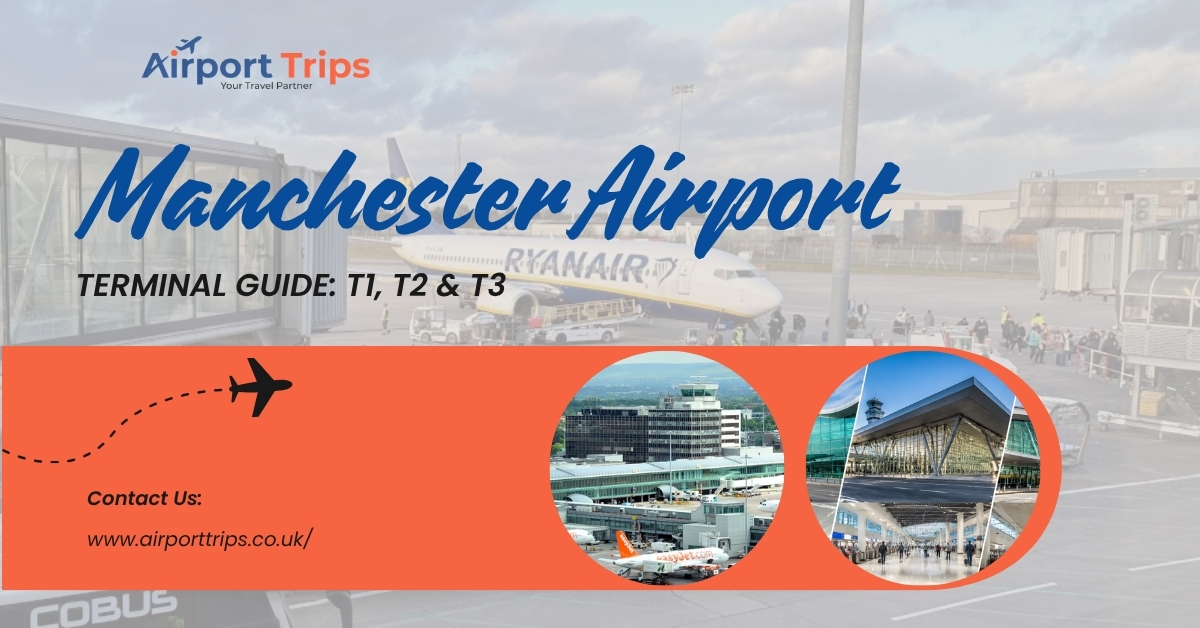
If you’ve flown from Manchester Airport before, you might be expecting to choose between three terminals. That’s no longer the case. As of late 2025, Manchester Airport operates as a two-terminal airport — Terminal 2 and Terminal 3 — after Terminal 1 permanently closed following a decade-long, £1.3 billion transformation programme.
This guide breaks down exactly which terminal you need, what’s changed, and how to make sure your taxi drops you at the right door — first time, no wrong turns.
Quick answer: Manchester Airport now has two active passenger terminals. Terminal 2 is the main hub, handling around 75–80% of all flights, including easyJet, Jet2, TUI, Emirates, Virgin Atlantic, and most international carriers. And the terminal 3 handles the remainder, primarily Ryanair and a number of short-haul and domestic routes. Terminal 1 closed for departures in November 2025 and no longer operates as a standalone terminal.
What Happened to Terminal 1?
Terminal 1 first opened in 1962, was opened by the Duke of Edinburgh, and served Manchester Airport for more than 60 years. It was never included in the airport’s ten-year expansion plan — instead, Manchester Airports Group (MAG) chose to consolidate operations into a vastly enlarged Terminal 2, which more than doubled in size to absorb the majority of Terminal 1’s traffic.
The majority of Terminal 1 closed on 19 November 2025. Airlines that used to depart from T1 — including easyJet and Emirates — completed their move to Terminal 2 around the same time. Rather than being demolished outright, parts of the old Terminal 1 building (its entrance, security hall, and World Duty Free area) have been folded into an expanded Terminal 3, which was officially rebranded in early 2026.
What this means practically: if you’ve got an old booking confirmation, travel guide, or even a bookmarked webpage that says “Terminal 1,” it’s out of date. Always check your airline’s app or your boarding pass for your current terminal before you travel — a number of airlines shifted terminals during the transition, and it’s the single most common source of confusion for passengers right now.
Terminal 2: The Main Hub
Terminal 2 is now Manchester Airport’s flagship terminal, and the centrepiece of the transformation programme. It’s more than doubled in size and now handles the large majority of the airport’s passengers — including most long-haul and international departures.
Airlines typically operating from Terminal 2 include:
- easyJet
- Jet2.com and Jet2holidays
- TUI
- Virgin Atlantic
- Emirates
- KLM
- Lufthansa
- Aer Lingus
- Qatar Airways
- Most other international and long-haul carriers
Facilities at Terminal 2:
A significantly expanded security hall with next-generation CT scanners, which generally means laptops and liquids can stay in your bag, and queues move faster than the old T1 setup
- A much larger departure lounge with more seating, shops, and restaurants
- Two piers, including double air bridges built to accommodate the Emirates Airbus A380
- Direct access to Manchester Airport railway station via the Skylink walkway
If you’re flying long-haul, on a package holiday with TUI or Jet2, or with one of the major international carriers, Terminal 2 is very likely where you need to be.
Terminal 3: Budget and Short-Haul
Terminal 3 has absorbed part of the old Terminal 1 building — including its former entrance and security area — as part of its own refurbishment, which completed in early 2026. It’s smaller than Terminal 2 and generally serves higher-frequency, shorter routes.
Airlines typically operating from Terminal 3 include:
- Ryanair
- A number of domestic and short-haul routes
Because Ryanair passengers currently enter Manchester Airport through what used to be the Terminal 1 entrance (now rebranded as part of Terminal 3), it’s easy to see why there’s still confusion about which terminal is which. If your booking says Terminal 1, and you’re flying Ryanair, you’re in the right place — just look for Terminal 3 signage rather than any leftover Terminal 1 branding.
Terminal 2 vs Terminal 3 at a Glance
| Terminal 2 | Terminal 3 | |
| Share of passengers | ~75–80% | ~20–25% |
| Typical airlines | easyJet, Jet2, TUI, Virgin Atlantic, Emirates, KLM, Lufthansa, most international carriers | Ryanair, select domestic and short-haul routes |
| Best for | Long-haul, international, package holidays | Short-haul, budget, domestic |
| Security | New CT scanners, larger hall | Refurbished as of early 2026 |
| Rail/tram/bus access | Direct via Skylink to The Station | Via Skylink and The Station, signposted onward |
Bear in mind that terminal assignments can and do shift as the airport continues to grow, so treat this as a general guide rather than gospel — your boarding pass is always the final word.
Why the Confusion Persists
Even though the switch to a two-terminal system is now well established, “Terminal 1” still shows up constantly in searches, old blog posts, and even some outdated signage in the surrounding area. A few reasons this confusion tends to stick around:
- Frequent flyers remember the old layout. If you flew from Manchester regularly before 2025, Terminal 1 was likely a familiar, well-worn routine — old habits are hard to shake, even after a rebrand.
- The physical building didn’t disappear overnight. Because parts of the former Terminal 1 structure were absorbed into Terminal 3 rather than demolished, some signage, taxi ranks, and even sat-nav pins took a while to catch up with the change.
- Airlines moved on different timelines. easyJet and Emirates were among the last carriers to relocate to Terminal 2, so if you last flew in mid-2025, your experience may not reflect where those airlines operate from today.
If in doubt, the safest approach is always to check your airline’s app in the days before you fly, rather than relying on memory, an old itinerary, or a general web search.
Which Terminal Do I Need?
The single most reliable way to confirm your terminal is your boarding pass or airline app — not a guidebook, a friend’s recent trip, or even the airline’s terminal from a few months ago, since several carriers changed terminals during the 2025 transition.
As a general rule of thumb for 2026:
- Flying long-haul, with a major international airline, or on a package holiday? You’ll most likely depart from Terminal 2.
- Flying with Ryanair, or on a short domestic hop? You’ll most likely depart from Terminal 3.
- Booking reference says Terminal 1? Check with your airline — it’s almost certainly been updated to either T2 or T3.
For a broader overview of the airport as a whole — parking, security wait times, and getting into Manchester city centre — our Manchester Airport Guide 2026 covers everything beyond terminals in one place.
Getting Between Terminal 2 and Terminal 3
If you’re dropping someone off, picking someone up, or have a connecting flight that requires a terminal change, it helps to know the two terminals aren’t right next to each other.
Terminal 2 connects to The Station — the airport’s train, tram, and bus interchange — via the Skylink, an enclosed, elevated walkway with moving travelators. From The Station, signposted routes lead through to Terminal 3. All told, the walk between terminals takes around 10–15 minutes, so if you’re catching a connecting flight that requires a terminal change, it’s worth allowing at least 20–25 minutes to account for any additional security screening along the way.
This is also worth knowing if you’re arranging a taxi: telling your driver the wrong terminal can mean an extra 10–15-minute walk you didn’t plan for, particularly with luggage or young children in tow.
Booking Your Taxi to the Right Terminal
This is where most of the stress around Manchester Airport’s terminal changes actually shows up — not in the flying itself, but in getting there. A taxi booked for the wrong terminal can mean a rushed dash across the airport, or worse, missing your check-in window entirely.
At Airport Trips, we ask for your terminal (not just “Manchester Airport”) at the point of booking, and our drivers know exactly where each terminal’s drop-off and pickup points are — including the current Terminal 3 entrance, which has moved from where it used to be before the transformation. If you’re not sure which terminal you need, tell us your airline and flight number when you book, and we’ll confirm it for you before your journey, so there’s no last-minute scramble.
For pickups, we also monitor your flight in real time, so if your gate or terminal changes, or your flight is delayed, we already know and adjust your pickup accordingly.
Whether you’re flying from the newly expanded Terminal 2 or the refreshed Terminal 3, you can book your Manchester Airport taxi through our services page and get a fixed fare with no surprises, no matter which terminal your airline has moved to.
Frequently Asked Questions
Is Manchester Airport Terminal 1 still open?
No. The majority of Terminal 1 closed on 19 November 2025 after more than 60 years in service. Parts of the building — its former entrance, security hall, and World Duty Free area — have been incorporated into an expanded Terminal 3, which was officially rebranded in early 2026.
Which terminal does easyJet use at Manchester Airport?
easyJet moved from Terminal 1 to Terminal 2 as part of the 2025 transition, and now operates from Terminal 2 alongside most other major and international carriers.
Which terminal does Ryanair use at Manchester Airport?
Ryanair operates from Terminal 3. Passengers currently enter via what was formerly the Terminal 1 entrance, which has been rebranded as part of the Terminal 3 complex.
How do I know which terminal I need?
Check your boarding pass or your airline’s app before you travel. Several airlines changed terminals during the 2025–2026 transition, so don’t rely on an older confirmation email, a previous trip, or a general guide — always confirm on the day.
How long does it take to walk between Terminal 2 and Terminal 3?
Around 10–15 minutes via the Skylink walkway and The Station interchange. If you have a connecting flight that requires a terminal change, allow at least 20–25 minutes to account for possible additional security screening.
What if I arrive at the wrong terminal?
Don’t panic — airport staff can direct you to the correct terminal, and the walk between them is manageable even with luggage. It’s still worth confirming your terminal in advance to avoid unnecessary stress, particularly if you’re on a tight connection.
Do I need to tell my taxi driver which terminal I’m flying from?
Yes. Terminal 2 and Terminal 3 have separate drop-off and pickup points, so telling your driver the correct terminal — or your airline and flight number if you’re unsure — means you’ll be dropped exactly where you need to be, with no extra walking.